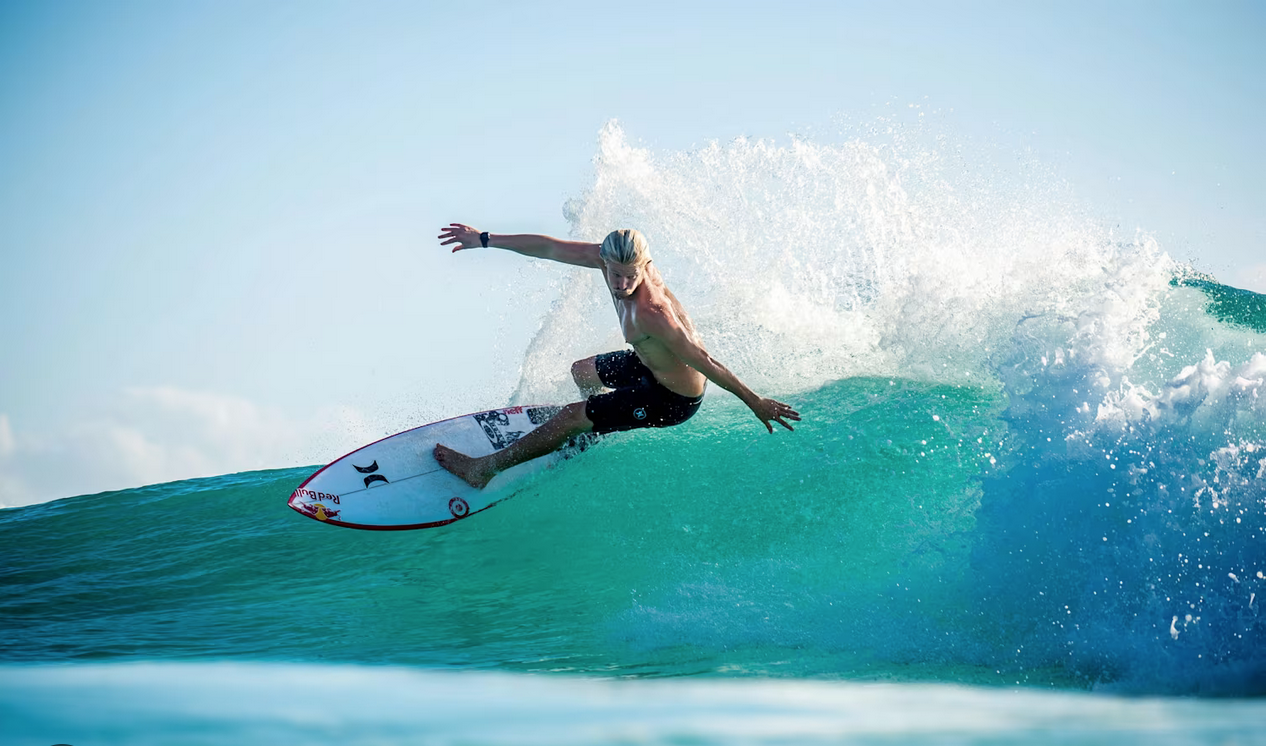
As we progress in surfing, we try different movements, skills, trajectories, and so on.
Like everything in life, some people have an almost innate ability to develop these techniques. They are so connected to the board that they feel it’s an extension of their body (like Rafa Nadal with his racket).
When we surf, we need to use our hips to make the board move forward, slow down, gain momentum, shift its center of gravity, and release the fins, or conversely, dig in a rail to carve, etc.
All of this, and much more, depends on the action of the hips, which at certain moments shift their position, transmitting the necessary thrust or lightness to the rest of the lower limbs and the soles of the feet. Since we’re talking about a kinetic chain, we can’t forget the upper body (the arm action) and the help of the head and gaze, which contribute to a streamlined and fluid movement, even mimicking a dance in certain surfing styles (retro, logboard, etc.). Similarly, for more radical maneuvers, these movements throughout the chain intensify, generating greater power, which is ultimately transmitted to the board.
What’s certain is that the key connector is the hip, home to one of the most powerful muscles in the human body: the iliopsoas, which connects the lower body (lesser trochanter of the femur) to the spine (lumbar vertebrae and internal iliac fossa).
At Llanes Garden, we have a foolproof technique to help improve these types of movements in a preparatory setting. Using a Bosu ball or a surfskate, we can enhance hip control and make corrections even while standing still, so we can later replicate those movements on the surfboard.
For this reason, the surf lessons we offer on the various beaches of Llanes incorporate the use of this equipment on the sand or even on asphalt.
‹ Back
The hips, the great steering wheel of the surfboard
Tags:
advanced surf lessons, progression, surf progress, surf technique
7. 3. 2024